Why Are Businesses Replacing Excel with Business Management Systems?
Is Excel Still Enough for Growing Businesses?
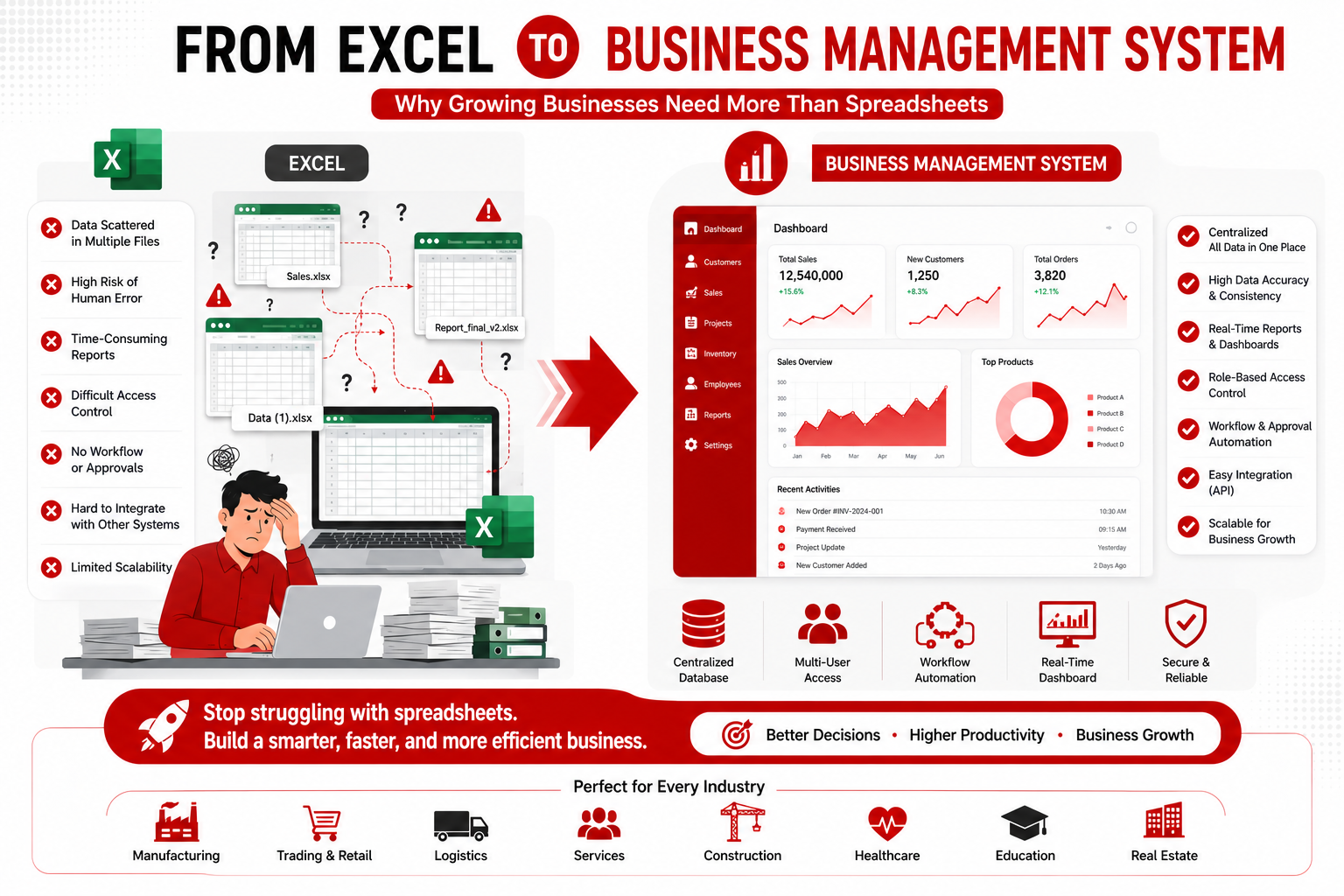
Microsoft Excel has been a popular business tool for decades. It is easy to use, affordable, and flexible for managing data, calculations, and reports.
However, as organizations grow, the volume of data, number of employees, and complexity of business processes increase significantly. Many companies eventually discover that Excel is no longer sufficient for managing operations efficiently.
As a result, organizations are increasingly adopting Business Management Systems to improve productivity, accuracy, and scalability.
Excel vs Business Management System
| Feature | Excel | Business Management System |
|---|---|---|
| Multi-User Collaboration | Limited | Fully Supported |
| Data Accuracy | Error-Prone | Controlled & Validated |
| User Permissions | Limited | Advanced Role Management |
| Data Search | Slower with Large Data | Fast & Efficient |
| Reporting | Manual | Automated |
| Workflow Approval | Not Available | Supported |
| API Integration | Limited | Extensive |
| Scalability | Limited | Highly Scalable |
1. Data Becomes Scattered Across Multiple Files
A common problem in growing organizations is that each department maintains its own spreadsheets.
Examples:
- Sales Team Spreadsheet
- Accounting Spreadsheet
- HR Spreadsheet
- Inventory Spreadsheet
This creates data silos and makes reporting difficult.
A centralized business system stores all information in one database, ensuring everyone works with the same data.
2. Higher Risk of Human Error
Excel files are easy to modify, which increases the risk of:
- Accidental deletion
- Incorrect formulas
- Duplicate data
- Outdated file versions
As the number of users grows, maintaining data accuracy becomes increasingly difficult.
3. Too Much Manual Work
Many businesses still rely on manual processes such as:
- Re-entering data
- Sending files by email
- Combining reports manually
- Updating spreadsheets repeatedly
Business systems automate these tasks and significantly reduce repetitive work.
4. Reporting Takes Too Long
Management often requires information such as:
- Sales performance
- Customer statistics
- Employee performance
- Project status
With Excel, preparing these reports can take hours or even days.
Modern business systems provide real-time dashboards and automated reporting.
5. Limited Access Control
Excel is not designed for enterprise-level permission management.
| Permission | Excel | Business System |
|---|---|---|
| View Data | ✔ | ✔ |
| Create Records | ✔ | ✔ |
| Edit Data | Difficult to Control | Fully Controlled |
| Approval Process | ✘ | ✔ |
| Audit Log | ✘ | ✔ |
6. Difficulty Scaling with Business Growth
As businesses grow:
- More customers
- More employees
- More transactions
- More operational data
Excel files become harder to manage and maintain.
Business systems are specifically designed to scale with organizational growth.
7. Lack of Integration with Other Systems
Modern businesses often need to connect with:
- Websites
- CRM Platforms
- ERP Systems
- Accounting Software
- Payment Gateways
- LINE Official Account
- Inventory Systems
Excel was never designed to serve as a central integration platform.
Signs Your Organization Has Outgrown Excel
| Sign | Priority |
|---|---|
| More than 5 critical spreadsheets | High |
| Multiple departments sharing data | High |
| Frequent data errors | High |
| Time-consuming reporting | High |
| Multi-step approvals | High |
| Need for dashboards | High |
| Need for system integrations | High |
Popular Systems That Replace Excel
| System Type | Purpose |
|---|---|
| CRM | Customer Management |
| HRM | Human Resource Management |
| ERP | Enterprise Resource Planning |
| Inventory System | Stock Management |
| Workflow System | Approval Management |
| Web Application | Custom Business Processes |
Conclusion
Excel remains a valuable tool for small businesses and simple data management tasks. However, as organizations grow, relying solely on spreadsheets can create challenges related to efficiency, data accuracy, collaboration, and scalability.
Implementing a Business Management System helps centralize information, automate workflows, improve reporting, and support long-term business growth.
If your organization spends too much time managing spreadsheets, preparing reports, or correcting data errors, it may be time to consider upgrading to a modern business management system.